Facebook ads for truck dispatch, insurance and factoring: how to turn leads into clients
Facebook and Instagram ads can put your offer in front of owner-operators and fleet owners every day. They can’t make those people trust you, accept your price or decide before they are ready. This is what to expect from Meta ads if you sell dispatch, insurance, factoring, IFTA and compliance, MC/DOT authorities or recruiting to trucking companies: what a good lead is, what a lead costs and what turns it into a signed client.
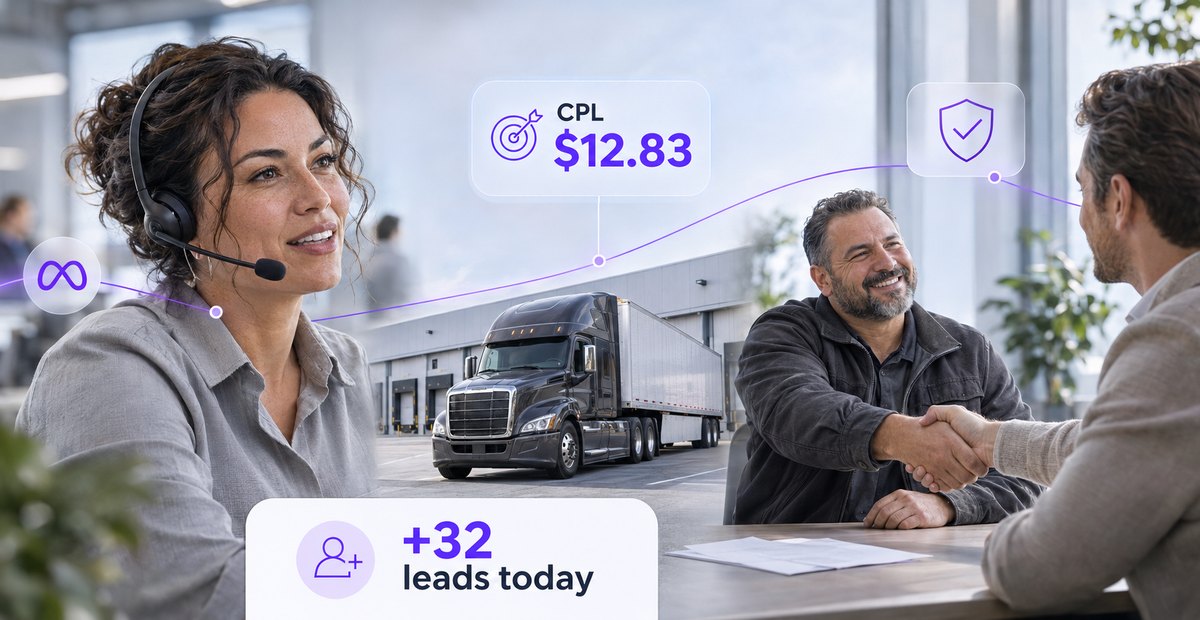
For more than 9 years Pixelco has run marketing for trucking companies and the businesses that serve them, 500+ companies in all. We know your clients well: owner-operators, fleet owners and carriers, how they choose a provider, what they check and what they've been burned by before. That's why we explain upfront how the process works and where each side's responsibility lies, before any budget is spent. Results come when well-run ads, a brand people trust and a fast, competent sales team work together.
Your clients are a narrow, demanding audience
You don't sell to everyone. Your client is an owner-operator, a fleet owner or a carrier who hears offers like yours every day. That changes how advertising works.
The audience is narrow
There are far fewer potential clients than in consumer niches, so a lead costs more. The goal isn't volume, it's the right people.
The decision takes time
Nobody picks a dispatcher, an insurance agent or an MC authority after one ad. People watch, compare and ask colleagues. It can take weeks.
The stakes are high
Their money, authority, safety score and trucks are on the line. Mistakes cost them a lot, so they choose carefully.
Many have been burned before
The industry has plenty of unreliable providers. A new client starts with caution and checks you before they reach out.
Word of mouth matters
Driver and owner-operator groups, reviews and referrals often weigh more than any ad. Your reputation works for you or against you every day.
Learning takes patience
In a narrow audience Meta needs more time to collect data and find the right people. Judging after a few days gives a false picture.
Ads find the right people and get your name in front of them. Whether they become clients depends on your reputation, your offer and how your team handles the first contact.
Ads bring attention. Trust closes the deal.
Before a business owner contacts you, they look you up. What they find decides whether they fill out the form, answer your call or move on.
Website or landing page
A clear page with your services, terms, contacts and real people behind the company. No website, or an outdated one, raises doubts right away.
Facebook and Instagram pages
An active page with real posts, client results and answers to questions. An empty page next to an ad looks like a one-day company.
Reviews and Google Maps
Real reviews and a Google Maps listing with your address and hours. In B2B this is often the first thing people check.
A consistent brand
The same name, logo, colors and message everywhere: in the ad, on the site and in social media. It shows you're an established business.
People, not a faceless company
The owner or team on camera, in posts and videos. In trucking services people buy from people they trust.
Speed and tone of replies
How fast and how professionally you answer comments, messages and calls. Clients judge your service by it.
These things aren't part of the Meta ads service, but they directly affect its results. A strong brand gets cheaper and warmer leads; a weak one makes every lead more expensive. If we see something that holds your ads back, we'll tell you upfront.
What Meta does well, and where its limits are
Meta is great at reaching the right business owners and getting your offer in front of them. It can't make them trust you, accept your price or decide faster than they're ready to.
Paying clients will come in the first week
Inquiries can start in the first days, but in B2B the path from a lead to a signed client is longer. People compare, ask questions and come back. We judge results on a timeline that fits your sales cycle.
Show the ads only to owner-operators with their own authority, or fleets of 10+ trucks
Meta has no targeting by fleet size, authority status or business type. We steer the audience through campaign settings, creatives, copy and form questions such as fleet size, state or years in business. The answers are self-reported, so your team confirms them on the call.
More leads means better results
In a narrow niche, ten inquiries from the right business owners are worth more than a hundred random ones. We optimize for fit, not just for volume.
Lots of cheap leads for high-value deals
The more a deal is worth, the fewer people are ready for it at any given moment, and the more each lead costs. Only so many owners are ready to sell or buy a trucking company in a given month, and no budget creates more of them. A lead for a deal worth tens of thousands of dollars can't cost the same as a lead for a $100 service. We measure success by closed deals, not by the number of leads.
Ads can make clients accept any price or terms
If your pricing, percentage or terms are weaker than competitors', people say no on the call. That's a response to the offer, not to the ad. We show your offer at its best; the offer itself is yours to set.
A winning creative works forever
Every creative burns out eventually, and in a narrow audience it can happen faster. At launch we test several creatives and ad sets to find the ones that work. After that we watch the data and refresh when the numbers start to drop. A winning creative keeps running for as long as it delivers.
The ad alone is enough
Almost everyone checks your website, social pages and reviews before reaching out. Ads amplify what's already there: they work best when your online presence backs them up.
We own the road to the inquiry. You own everything after it.
A new client only happens when both sides do their part. Here is the path from the first ad view to a signed deal.
| Stage | Owner | What it includes |
|---|---|---|
| 1. The offer | Client | Services, pricing, terms, guarantees, what makes you different |
| 2. Online presence | Client | Website or landing page, social media pages, reviews, Google Maps. We point out what affects ad results |
| 3. Ads and creatives | Agency | Campaign structure, audience, copy, video scripts and editing, banners, testing and budget optimization. Filming is on your side |
| 4. Lead form | Shared | You decide which criteria matter. We build the form and show how each question affects the cost |
| 5. Lead delivery | Shared | Meta Leads Center works from day one. For a CRM, we provide the form details and access; your team connects it with the CRM's support |
| 6. First contact | Client | Calls, texts, replies to comments and page messages |
| 7. Sales and follow-up | Client | Consultation, proposal, follow-up over days or weeks, closing the deal |
| 8. Lead feedback | Client → Agency | A status for every lead once a week. Without it we optimize blind |
We can't guarantee a number of signed clients, because everything from the first call to the deal happens on your side. We do answer for the setup and quality of the campaigns, a steady flow of inquiries that match your criteria, and acting on the data as soon as something changes.
What a good lead from Meta actually is
A good lead is a business owner from your target audience who left a real contact and showed interest in your service. Signing a contract is not part of this definition: it depends on your offer and your sales process.
A lead is qualified if
- They are in your target audience, for example an owner-operator or a fleet owner, per the form
- They are in the area you serve
- They match your basic criteria: fleet size, authority status, state, per the form
- The contact is real, and they answer a call or message at least once
- They are interested in your type of service
This does not make a lead bad
A truly bad lead is on us, and in our campaigns it's a rarity
A different country, someone with no connection to trucking at all, a fake number. Campaign settings, form questions and SMS verification screen them out before they reach you. If one does slip through, send us examples, and we'll trace where it came from and fix the setup.
We recommend SMS phone verification
The person confirms the phone number with a code before submitting the form. That keeps out bots, typos and fake numbers. The trade-off: some people won't finish the form, so there are fewer leads and each costs a bit more.
One person, several inquiries: a hot lead
The same business owner may fill out several forms or write both a comment and a message. That's not a glitch, it's a sign of strong interest. Contact them first.
Why cost per lead is different for every business
There's no single market price for a lead. It depends on what you sell, to whom and with what offer.
Type of service
Dispatch, insurance, factoring, MC sales or recruiting each have their own audience size and competition.
Who you target
Owner-operators are a larger audience than fleet owners with 10+ trucks, and each costs differently.
Geography
Nationwide or specific states: the audience size and the number of competitors change the auction price.
Strength of the offer
Clear pricing, guarantees and real advantages get more responses for the same money.
Trust in your brand
A known name with reviews and an active page gets cheaper leads than a company nobody has heard of.
Length of the form
Each additional question means fewer submissions and a higher cost per lead, but better filtering. A trade-off we balance together.
Season and competitors
When competitors raise their budgets, the auction gets more expensive for everyone.
Fresh creatives: on us
A burned-out creative makes leads more expensive. We track response to every creative and replace it before the drop shows up in your cost per lead.
High-value deals: count the deal, not the lead
For services where one deal is worth tens or hundreds of thousands of dollars, such as buying and selling trucking companies or MC/DOT authorities, the usual lead math doesn't apply.
- The pool is limited. At any moment only a small share of owners is ready to sell or buy. A bigger budget reaches them faster, but doesn't create more of them.
- The lead price follows the deal value. Serious buyers and sellers are few and in demand, so each such lead costs more than in mass-market niches. A lead that is cheap and plentiful in this niche is usually a lead with no real intent.
- The math that matters. Compare the ad spend with the value of the closed deals it brings. A single deal can pay for many months of advertising.
Your own benchmark appears in 2–3 weeks
Instead of comparing with numbers from the internet, we build your benchmark from your own campaigns.
Not the cost per lead, but the cost per signed client. To count it, we need lead statuses from your side.
Comments, messages and reputation bring clients too
Not every interested business owner fills out the form. Many first ask a question under the ad or message your page.
Comments under ads
People ask about pricing and terms right under the ad, and others read the answers. A quick, professional reply builds trust; an ignored question pushes people away.
Direct messages
Messages to your Facebook and Instagram page are leads too, and often warm ones. They need an answer within hours, not days.
Public reputation
Negative comments happen in any niche. A calm, professional public reply often works better than any ad.
Illustrative examples, not a client account.
- Comments and page messages are handled by your team. The agency runs the ads; replying to people is part of first contact. A missed comment is a missed client.
- A "+" or "info" in the comments means "I'm interested". Message this person in Messenger or Instagram Direct the same day.
- Reply under the ad briefly and professionally, then move the conversation to messages or a call. Other potential clients read these replies too.
Your sales team decides the outcome
Ads deliver a contact. Your team turns it into a client. The same leads in different hands give very different results.
Our recommended time to the first call after an inquiry. The person still remembers your ad and hasn't talked to competitors yet.
Follow-up
In B2B one call is rarely enough. Plan several touches over days and weeks: calls, texts, messages.
Expertise on the call
Business owners can tell a script from someone who knows the industry. Confident, specific answers close deals.
A status for every lead
That's how we see which ads bring clients, not just inquiries.
Speed
Call within 5 to 15 minutes of an inquiry, while your ad is still fresh in their mind.
Why people don't pick up
Usually it's not about lead quality. The most common reasons:
- Your number shows up as spam. Many business numbers get flagged as "Spam Likely", and people simply don't answer.
- The call came too late. A few hours later, the person is busy or has already talked to someone else.
- A competitor got there first. In a competitive niche, the fastest reply often wins.
- They're busy. Owner-operators are often driving; fleet owners are in operations. Try another time and send a text.
If leads massively don't answer, first check that your number isn't flagged as spam. If the number is clean and the problem continues, we review and relaunch the campaign.
A fast, professional first reply is the cheapest way to lower your cost per client.
What Meta ads cost
Two payments, and nothing per lead or per client on top. The ad account, the pages and the leads stay yours.
| Payment | Cost | What it covers |
|---|---|---|
| Service fee | $2,000 a month | Strategy, campaigns, creatives, the lead form, optimization and weekly reports |
| Ad budget | from $2,000 a month | Paid straight to Meta from your own ad account |
How far the budget goes depends on the service, the audience and the states you cover. The first two to three weeks give you your own cost per lead, and after that you can plan the budget from the number of clients you need.
Before launch
- We study your offer, your clients and competitors' ads in your niche
- Campaign structure by service, audience and geography
- Several creatives and ad sets launched at once to find the winners fast
- Video scripts and editing, banners and several versions of ad copy (you film the footage from our scripts)
- A lead form built around your key criteria, with SMS phone verification (recommended)
- Everything your team needs to connect a CRM: form details and access
Every week
- Creative performance tracked, new ones tested when the data calls for it, weak ads turned off
- Budget moved to the ads that bring real conversations and clients
- Truly bad leads traced to the source and fixed
- Optimization by your lead statuses, aimed at cost per client
- A report: lead cost, volume and quality by ad and service
Frequently asked questions
How much do Meta ads cost for a trucking service company?
$2,000 a month for our service, plus an ad budget from $2,000 a month that you pay straight to Meta. There is no fee per lead or per client.
How much does a lead cost for a dispatch, insurance or factoring company?
There is no single price. It depends on the service, the audience, the states, the offer and the length of the form. Your own benchmark shows up after 2 to 3 weeks of running, and from then on results are compared against it.
Can the ads reach only owner-operators with their own authority?
Meta has no targeting by fleet size or authority status. The audience is steered with the creatives, the copy and the questions in the form, and your team confirms the answers on the call.
How soon will I get clients?
Inquiries can start in the first days. Signed clients follow your sales cycle: owners compare and come back, so in B2B that usually takes weeks, not days.
Do you guarantee a number of signed clients?
No, because the call, the offer and the follow-up happen on your side. We answer for the campaigns, a steady flow of inquiries that match your criteria, and fixing the setup as soon as the data says so.
Selling to trucking companies?
Book a call. We will look at your offer and your pages and tell you what to expect from Meta ads before you spend anything.
Book a call