Marketing brings the drivers in. Automation keeps them: a marketer and an automation expert on growing a trucking company
A trucking company pays for every application, then loses many of them to slow calls, lost texts and expired paperwork. In this interview, two specialists look at the problem from both sides: Alina Nauruzova, co-owner of Pixelco, on marketing, and Iryna Dudnyk, CMO of GurVer Inc., which owns Bizura TruckPro, an expert solution for automation and recruiting operations. Today they talk about where carriers lose drivers between the ad and the hire, what marketing can and can’t fix, what automation takes off the recruiter’s plate, and why safety data matters for hiring.
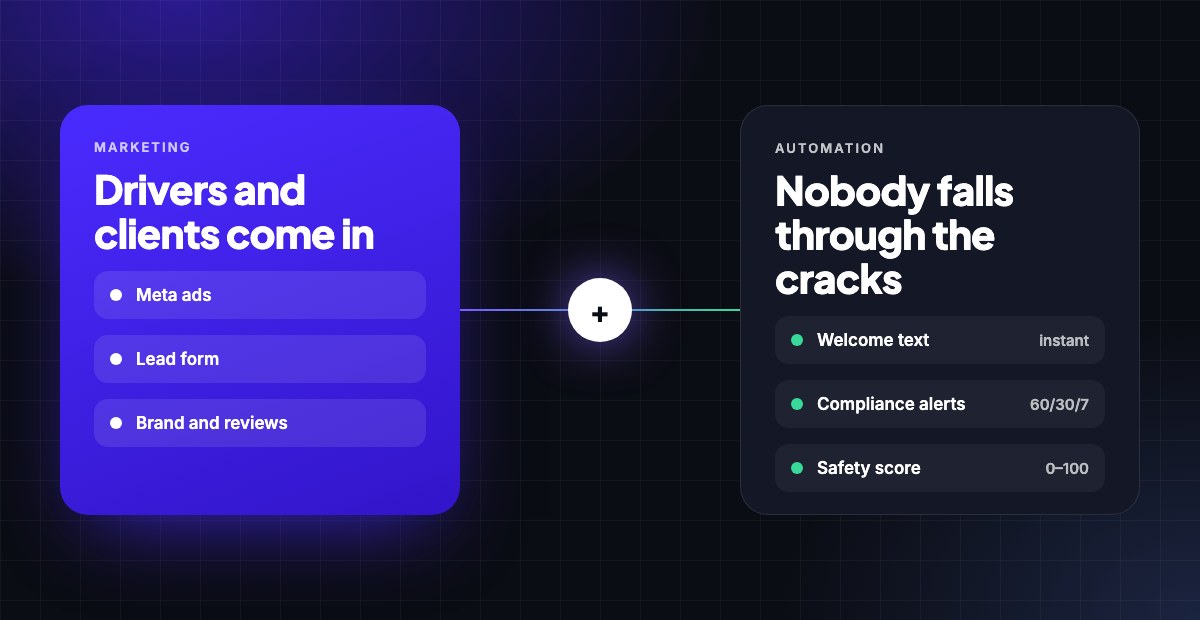
Pixelco brings drivers and clients to trucking companies. Bizura TruckPro, an operating and hiring system for trucking companies, handles what comes next, so they don’t slip away. Most carriers we meet have a gap exactly where one side ends and the other begins.
Two companies, one trucking company to grow
Pixelco runs marketing for trucking companies: ads, brand and driver recruiting. Bizura TruckPro handles what comes next: follow-up, communication and compliance. Safety Carma adds the safety data. Here is how the two sides fit together.

Alina Nauruzova
Co-owner, Pixelco
Co-owner of Pixelco (https://pixelcous.com), a marketing company for the trucking industry, with 19 years in marketing. Pixelco runs Meta Ads, Google Ads, social media and branding for carriers and trucking vendors, with 500+ trucking companies served. Named Best Marketing Company of the Year.

Iryna Dudnyk
CMO and Growth Strategist, GurVer Inc.
Chartered Marketer with 15+ years in marketing. GurVer Inc. builds and runs Bizura TruckPro (https://bizura.io/truckpro), the all-in-one operating system for trucking companies, from driver recruiting and compliance to communications and growth.
Most drivers and clients are lost after the ad, not before it
A carrier can pay for a good application and still lose the driver. The leak usually sits between the form and the first call.
Slow first contact
An application waits hours for a call. By then the driver has talked to two other carriers.
No follow-up
A driver who didn’t pick up once is never called again. Paid leads go cold in a spreadsheet.
Scattered conversations
Texts, calls, WhatsApp and email live in different apps and different phones. Nobody sees the full history.
Paperwork by hand
CDL, medical card, drug test and insurance dates tracked in a notebook. One expired document can ground a truck.
A safety record nobody reads
Drivers, shippers and insurers check your FMCSA data. Many owners have never looked at it in plain terms.
A thin online presence
Few reviews and an old website make every ad work harder and every lead cost more.
Marketing decides how many of the right people reach you. Process and software decide how many of them you keep.
What marketing can and can’t do for a carrier
What does a carrier actually get from Meta Ads?
A steady flow of drivers, not just a list of phone numbers. We build the campaigns around the positions you need to fill, the offer you’re making and the requirements for each role. Owner-operators, solo drivers and teams each get their own campaign and form, with questions about CDL experience, truck year, drug-test history, violations or willingness to run OTR.
So the recruiter knows who they are calling before the first call. The form is a filter, and the recruiter still confirms the details on the phone.
That is how our clients hire for a few hundred dollars in ads per driver, against $10,500 and up through a staffing agency. The numbers from our recent cases are in the next section, and they hold when the carrier works the applications fast.
Where does marketing stop?
At the application. Two carriers can spend the same amount and receive the same 100 applications. One hires one driver, the other hires five. The difference is rarely the ads. It comes down to how quickly the recruiter calls, how consistently they follow up, whether the offer fits what drivers are looking for and how specific the company’s requirements are. Marketing brings the applications in. The carrier’s recruiting process decides what happens next.
So what do you tell clients before launch?
Have someone ready to call new applicants within five minutes, and keep following up if a driver doesn’t answer. We also agree on the position, the offer and the hiring requirements before we build the campaign, so the ads and the form reflect what the company actually needs. The campaign brings in the applications. The recruiting team needs to be ready to work them.
Nine questions on hiring drivers with ads
Alina answers what carriers ask most often about paid recruiting: cost, the Special Ad Category, creatives, social media and where to start.
What does it really cost to hire a truck driver?
It depends on the channel. A staffing agency charges $10,500 to $17,500 per seated driver, often 15 to 25 percent of first-year pay. A flat-fee recruiter takes $1,250 to $3,500 per hire. With paid ads you pay for the ads and for the team that runs them, and your own recruiter makes the hire.
Here is what it looks like in our recent cases, in ad spend per driver hired: $306 for Delo Trans, $456 for STL Truckers, $685 for Pickup Master Logistics, $720 for Aral Cargo and $898 for Drivers Hub. Against $10,500 and up through an agency, that is a fraction of the price. Each number belongs to its own period, market and type of driver, and the ad market keeps shifting, so we always show a cost per hire together with its period. What doesn’t change is how we get there. We sharpen the offer together with the carrier, test dozens of creatives, judge every ad by hires and keep only what brings drivers. Paired with a recruiter who calls back fast, that is how our clients fill seats for a fraction of what an agency charges for one.
Why is cost per lead the wrong number to watch?
Because a cheap lead that never becomes a driver is money spent on nothing. There is no standard price for a lead. It depends on the company, the offer, the lanes and the market, so every carrier ends up with its own number. Chasing the cheapest lead at any cost is a losing game: you get more names and fewer drivers.
We do watch the cost, every day. But the first thing we look at is feedback from your recruiters: who picked up, who qualified, who came to orientation. An ad stays in the account only when its price and the quality of its drivers both hold up. Sometimes the ad with the more expensive lead brings the cheapest hire, and that is the one we scale.
Meta now runs job ads under a special category. Does it still work for trucking?
Yes, it works, and we built our whole approach around it. Every job ad on Meta now runs under the Special Ad Category for employment. That means fewer targeting options: you can’t choose drivers by age, gender or ZIP code, and the smallest area you can target is a 15-mile radius.
So Meta decides more of who sees the ad, and our job is to make sure the right driver says yes. That comes down to four things: a clear offer, creatives with real numbers, a form that filters out the wrong candidates, and constant testing.
The biggest lever is how we split the campaigns. Company drivers and owner-operators get separate campaigns. Each terminal or lane gets its own. Whatever profile you hire for, whether recent CDL grads or drivers with 2+ years of verifiable experience, solo or team, local, regional or OTR, it gets its own campaign, its own message and its own form. Every campaign speaks to one type of driver, so Meta learns faster who to show it to. Meta took away a lot of targeting. It didn’t take away our results. Since the change, we keep bringing carriers the drivers they hire for, company drivers and owner-operators alike. You tell us who you need, and we build campaigns aimed at exactly those drivers.
What makes a recruiting ad that drivers actually respond to?
Numbers on the image. CPM or weekly pay, lanes, home time and equipment, right where the driver sees them. “Competitive pay” tells a driver nothing. Real trucks and real people beat stock photos.
And we never run one version. For Frontliner Inc we tested weekly gross against net take-home for owner-operators, in several styles. For Top US Logistics we added a campaign fully in Spanish, and during that campaign it brought the largest share of leads at the lowest cost.
How is recruiting owner-operators different from hiring company drivers?
An owner-operator is not a job seeker. They run a business and compare the math: the pay model (percentage of the load or per mile), the realistic weekly gross, how settlements are paid and explained, and how dispatch works. A headline percentage means nothing if the numbers after deductions don’t hold up.
A small carrier can win here. Direct access to the owner, faster decisions, no forced dispatch. When the ad shows that, it works: JDM Co Freight hired 11 owner-operators in one month, and Linestar Logistics was hiring 15 to 20 a month during the period in our case.
If ads bring the applications, why does a carrier need social media?
Ads bring the applications. Social media is what makes a driver trust the company behind them. Before a driver applies, or picks up when your recruiter calls, they look you up. An empty account, or three posts from years ago, can make a real carrier look like a fly-by-night company or even a scam.
What builds trust is real life: your trucks and your yard, your dispatchers and drivers with real faces and names, the freight you haul, a new driver’s first day. You don’t need to be a media brand. A steady account that shows a real company with real people is enough.
That is why we treat social media as part of hiring, not decoration. It backs up what the ad promises, makes your name familiar and gives drivers a reason to choose you over the next carrier. STL Truckers shows how it works together: in one quarter with the account running alongside the ads, it got 419 company driver applications at $14.14 each and hired 13 drivers at $456 each.
When should a carrier add Google Ads?
When Meta already brings drivers steadily and you want more. Meta reaches drivers who aren’t looking yet. Google catches the ones who type “CDL jobs Dallas” today. That click costs more, but the driver behind it is already comparing employers.
With Google, a lot depends on your landing page. On Meta the driver fills in a form without leaving the app. On Google every click goes to your website, and that page decides whether the driver applies. However well the campaign is set up, you can get steady traffic and plenty of clicks and still see no applications, because the page loses the driver.
That is why, before we launch Google Ads, we always start with the landing page. CPM or weekly pay, lanes, home time and equipment are visible right away, the page loads fast on a phone, and the application takes a minute, not fifteen. Only then do we start paying for clicks.
Together the channels cover both sides of the market. Delo Trans runs Meta, Google, social media and YouTube with us, so a driver who sees their ad, searches the name and opens their channels finds the same real company everywhere. That is what turns recruiting into a steady flow: in one quarter of 2026 the system brought Delo Trans 2,287 driver applications, about 25 a day, at $306 of advertising per driver hired.
Where should a small carrier start?
Under fifteen trucks, start with Meta. We build a short instant form for you: contact details fill in automatically, and a few screening questions on CDL class, experience and driving record do the rest. Plan a steady monthly budget rather than a few test days: we start hiring accounts from $2,000 a month in media budget, because below that an account never gets out of the learning phase.
Before launch, get the basics in place: at least nine posts on Instagram and Facebook, and your company on Google Maps with a complete Google Business Profile. Ask your current drivers to leave reviews there. A driver who looks you up should find a real company that real drivers recommend.
Then keep it running. A campaign stopped for two weeks after you fill a seat loses what it has learned, and the next one pays to learn it again. And make sure your recruiter answers every application within five minutes. That is the setup we start every new carrier with.
How fast will the first drivers come?
Applications usually start inside the first week. Hires take longer, because the driver still has to talk to your recruiter and pass the MVR, drug screen and background check, then get through orientation.
The first 30 days are for learning. Meta finds out who responds, and we cut the ads that bring leads but not drivers. After that, every week of data makes the next decision sharper.
How fast the numbers move depends on the market, your offer and how quickly your team calls back, so we won’t put a date on it. What we can show is where carriers who stay with us end up. Alif Uz Corp has run Meta Ads with us since 2022, and its case shows 20+ drivers hired every month at $213 each.
What happens to a lead once it arrives
Why do carriers lose applications they already paid for?
Because the work after the form is mostly manual. A recruiter has dozens of applications, several phones and no reminders. In one carrier’s data we reviewed, about one in four of the leads it had paid for in its largest market was still waiting for a first call, and those open leads had received only 1.6 contact attempts on average. The ones who don’t answer the first call often disappear.
What happens in the first minutes after a driver applies?
The driver gets a welcome text right away, and the team gets a notification about the new lead, so a recruiter can make the first call ideally within 5 minutes, and within 10 at the most. That window matters. In our experience, after ten minutes the chance of reaching the lead drops by about half. The automation handles the notice and the welcome, so the recruiter starts calling instead of typing.
What if the driver doesn’t pick up?
A sequence takes over. The driver gets reminders that we tried to call, with a simple way to choose the best time and book a callback in the calendar. The recruiter doesn’t have to remember to try again, and the driver picks the time that suits them.
What about drivers who are still thinking, or already in progress?
They get follow-up reminders at those stages too. Nobody is forgotten because a recruiter had a busy week, and the recruiters get more time for the warmer leads and for the hiring process itself.
How do documents and the application work?
The request for the CDL, the medical card and the application is automated. The driver sends the documents, and if the application or a document is still missing, a sequence of reminders keeps them moving until it is done. The documents are collected in one place and tied to the driver’s contact record. The recruiter still confirms that the application is complete.
And the leads that went quiet?
Reactivation and nurturing campaigns keep reaching drivers who weren’t interested at first or were never reached, with reminders and offers from the company, so the carrier gets the most from every lead it pays for. At one carrier, going back to written-off leads put 15.2% of them back into live recruitment, at no extra ad spend.
What did that change at a real carrier?
The recruiting team now spends its time where it counts: new, hot leads first, then candidates in active recruiting who need a push at their stage. Follow-ups, document reminders and weekend coverage run automatically, so nothing waits when the recruiters are busy. In that carrier’s latest report, the incoming leads stage went from 50 to zero, and every new lead was worked during working hours, with the first call aimed within the first 10 minutes. Candidates in the middle of the funnel grew from 4.9% to 24.1%, and later stages from 0.7% to 5.8%. About 68% of candidates who entered the document reminder sequence submitted their documents. Workable leads reached 72%. In the first full week, hires went from 3 to 5.
And after the driver is hired?
Compliance is where trucks get grounded. The compliance tracker in Bizura TruckPro follows CDL, medical card and insurance dates and sends expiry alerts ahead of time (60, 30 and 7 days before). Onboarding documents are collected digitally into the driver file.
What about conversations the driver starts?
Every channel the carrier uses comes into one inbox: phone calls, text messages, email, WhatsApp, and Facebook, Instagram and TikTok messages. A driver who writes to the company page at night, or answers a text a day later, lands in the same conversation as the rest of the history. A conversation the driver starts is never missed, and anyone on the team can pick it up and see everything that was said.
What if there are more leads than the team can handle, or applications arrive after hours?
A conversational AI and an AI voice agent can take some of the pre-screening steps. They ask the first questions and collect the answers, so a lead is already screened when a recruiter picks it up. This is useful when lead volume grows faster than the team, and for after-hours and weekend coverage, when nobody is at a desk. It is an option the carrier can switch on, not a requirement. The recruiters keep the conversations that matter and the hiring decisions.
GurVer program data, one carrier, Aug to Nov 2026. Early results.
From the first ad to a hired driver
Each stage has an owner. When one is missing, the money spent on the stages before it is wasted.
| Stage | Owner | What happens |
|---|---|---|
| 1. Offer and brand | Carrier | Pay, lanes, home time, equipment. A profile and reviews that back them up |
| 2. Ads and lead form | Marketing | Creatives with the numbers on the image, a form that filters, budget and optimization |
| 3. Instant reply | Automation | Welcome text right away, team notified to call within minutes. |
| 4. Calls and follow-up | Carrier | Recruiter calls. Automated reminders and callbacks keep leads moving, including weekends and after hours. |
| 5. Offer and onboarding | Automation | Document and application reminders, e-signature contract, orientation and safety onboarding help. |
| 6. Compliance and retention | Automation | CDL, medical and insurance expiry alerts, retention and reactivation campaigns. |
| 7. Feedback to marketing | Carrier → Marketing | Reporting shows which sources bring hires, so budget follows. |
Why a safety score matters for marketing too
Why should a carrier watch its safety data?
Because everyone else already does. Drivers, shippers and insurers can open your FMCSA record. The data is public, but understanding it means digging through several portals, records and PDFs.
Safety Carma, part of the Bizura TruckPro family, pulls it into one place: a 0 to 100 score, the six BASIC categories with their percentiles, intervention thresholds and alerts, and the actual roadside inspections and violation codes behind each number. Alerts are never hidden inside the total, and every category shows its source and date. Check it on desktop or mobile, wherever your team works.
How does a carrier get started?
Safety Carma starts with the USDOT number. The dashboard reads the public record: inspections, violations, crashes, BASIC data, insurance and operating authority. Then you review the score, the thresholds and the records driving it. Owners can invite safety managers and dispatchers so the whole team works from the same view.
Carrier data refreshes daily, so the team sees new inspections and alerts as they appear.
Is the score an official rating?
No. Safety Carma is a plain-English summary built on public FMCSA and U.S. DOT data. It is not an FMCSA safety rating and does not predict FMCSA action.
How does that connect to recruiting?
Experienced drivers check carriers before they apply. A clean record and good reviews make the same ad bring better applications. A weak record makes every hire cost more, and no creative fixes that. That is why safety data belongs in the recruiting conversation, not only in the safety office.
Would you like early FREE access to Safety Carma? Request it here: https://safetycarma.com/early-access
What owners expect, and what actually happens
More ad budget means more hires
More budget means more applications. Hires grow only if the team can answer and follow up on all of them.
A CRM will hire drivers on its own
Software keeps every lead and reminder in place. People still make the call and the offer.
Compliance can wait until audit time
One expired medical card can take a truck off the road. Expiry alerts ahead of time help you renew before it matters.
Drivers don’t look at safety data
Experienced drivers and shippers check it. Your record is part of your brand.
A checklist for the next 30 days
Marketing
- Write the offer down: pay, lanes, home time, equipment, requirements
- Update the social profile and ask happy drivers for reviews
- Separate ads for company drivers and owner-operators
- Agree who calls new applications and how fast
Automation
- Put every application into one pipeline
- Turn on an instant reply and a follow-up sequence
- Load CDL, medical and insurance dates and set alerts
- Check your safety score (for example in Safety Carma) and the violations behind it
Frequently asked questions
Do we need both marketing and automation?
Marketing without a process loses paid leads. Software without a steady flow of applications has nothing to work with. Most carriers start with one and add the other once the gap shows.
How fast does a carrier see results?
Applications from ads can start within the first week of launch. Setting up Bizura TruckPro typically takes about 2 weeks: setup and team onboarding, recruiting, compliance and communications. The pipeline starts working from the first lead, and carriers see the first results within the first week of official launch.
Is a safety score from these tools an official FMCSA rating?
No. Safety Carma is a summary of public FMCSA data. It is not an FMCSA safety rating and does not predict FMCSA action.
Who owns the data and the ad accounts?
The carrier. The ad account, pages and leads stay on the carrier’s own assets, and the driver list in the CRM belongs to the carrier.
Want more hires from the same budget?
Book a call with Pixelco and we will show you where your recruiting loses drivers and how to reach your hiring goal.
Book a callSee how Bizura TruckPro keeps the drivers you pay for: https://bizura.io/truckpro