Meta ads bring drivers to your door. Your offer and your recruiters hire them.
A practical guide for trucking companies: how Meta advertising works, what we as your marketing team are responsible for, what stays on your side, and what counts as a quality lead.
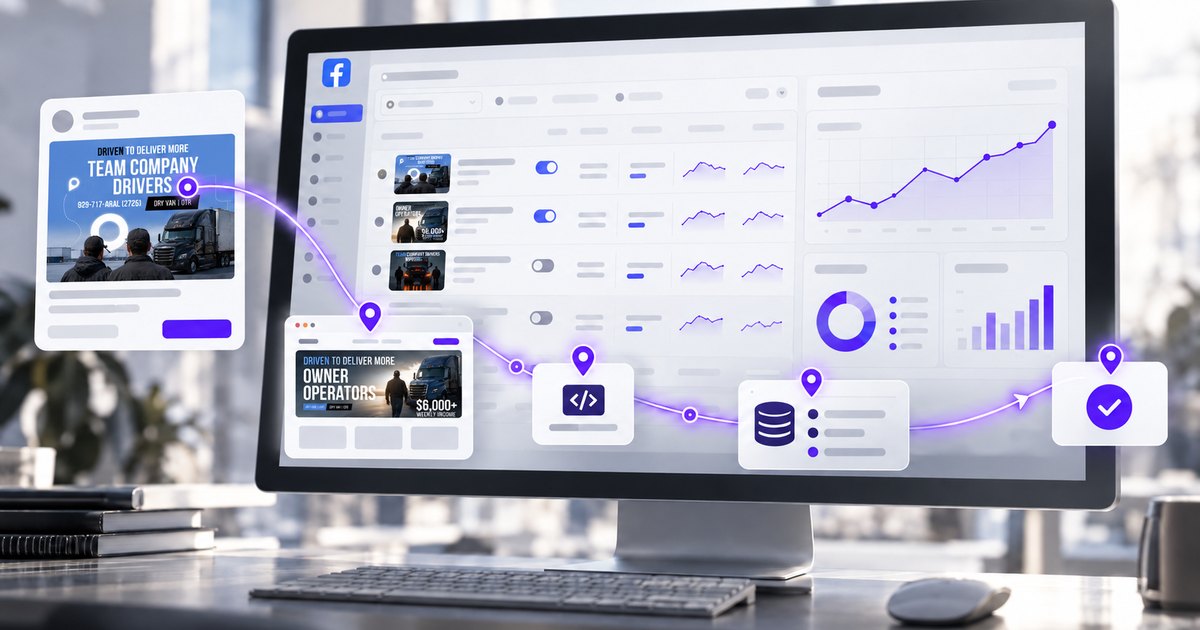
For more than 9 years we've been running marketing for trucking companies, including driver recruiting ads. Over that time we've seen that promises of "ready drivers from day one" bring an impressive start and disappointment a month later. We work differently: we explain upfront how the process works and where each side's responsibility lies, and we take full ownership of ours. Results come when a strong offer, a fast recruiter call and well-run ads work together. That's when Meta becomes a steady source of drivers.
Meta is an auction for attention, not a database of ready drivers
Meta doesn't hand out drivers from a database. It runs an auction, and our job is to win it for you: we choose the geo, present your offer, build the creatives and the form, and the algorithm uses them to find the drivers most likely to respond. Here is what happens every time a driver opens Facebook or Instagram.
Advertisers compete
Dozens of advertisers bid for the same spot in the driver's feed, other carriers included.
Meta predicts a reaction
The ad most likely to get a response from that particular person wins the spot.
The algorithm learns
Every submitted form teaches Meta who responds, and it looks for more people like them.
It needs time
Roughly the first week after a launch or a major change is a learning phase. Cost and lead quality swing during it.
Changes follow data, not days
A new form, new states, a sharp budget change or new creatives restart learning. That's why we make changes when the data calls for them, not every couple of days. Switching settings back and forth doesn't bring results faster: the algorithm never gets time to learn, and results get worse.
The creative is the main filter
The video and the copy decide who responds. That's why we keep testing and refreshing creatives.
It learns from forms, not hires
Meta doesn't know who answered the phone or who got dispatched until you tell us. Your lead feedback is how it learns to find better drivers.
The market moves the price
Season, freight rates and competitors' budgets change your cost per lead even when nothing changes on our side.
Advertising brings a driver to the door. Your offer and your recruiter decide whether they walk in and stay.
What Meta does well, and where its limits are
Meta is great at showing your job to the right people and collecting their contacts. It can't make a driver qualified, honest or happy with your terms.
Every lead is a ready-to-hire driver
A lead is a person who got interested and left a contact. The hiring decision happens on the call and in your screening.
Show the ad only to drivers with a clean MVR
Meta knows nothing about MVR, CDL, experience, drug tests or criminal history, so that kind of targeting doesn't exist. We can ask about it in the form, but the driver answers in their own words, and the answer isn't a guarantee. The facts are confirmed by your screening.
Show the ad only to the drivers we need, e.g. company drivers
Meta has no targeting by driver type: company solo, team, owner-operator, lease purchase, local and OTR drivers all see the same ad. We steer the audience with creatives, ad copy and form questions, and that filters out most of the wrong fit. Still, a driver can apply for a position that doesn't suit them, so some mismatches are normal.
Set the ads so every candidate is, say, 35 with 5+ years of experience
Meta doesn't let anyone set an exact profile for every candidate. We steer the audience in other ways: the form asks for the ZIP code and years of experience, and the creatives and copy speak to experienced drivers. The algorithm learns from the people who apply and then looks for more like them, so over time the audience shifts toward the most active drivers who fit your job.
A winning creative works forever
Every creative burns out eventually, but each one has its own lifespan: one lasts a couple of weeks, another more than a month. At launch we test many creatives and ad sets at once to find the ones that work. After that we don't replace them on a schedule: we watch views, clicks and form submissions, and refresh when the numbers start to drop. A winning creative keeps running for as long as it delivers.
Ads can make drivers accept any terms
If a driver won't do 4 weeks OTR, wants higher pay or a newer truck, that's a response to the offer, not to the ad. No ad makes a driver say yes when competitors offer more. We show your offer at its best and bring in the drivers it fits. The offer itself is yours to change.
We own the road to the application. You own everything after it.
A hired driver only happens when both sides do their part. Here is the driver's path from the first ad view to the first dispatch.
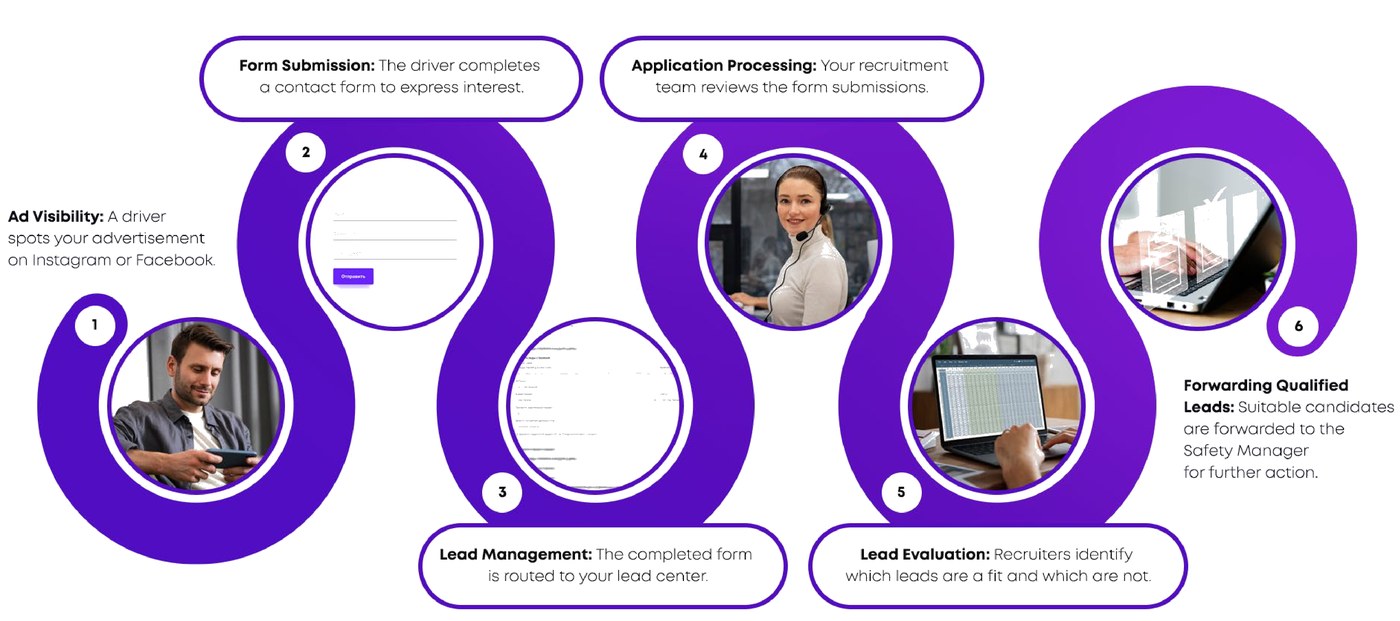
PixelCo: ads and applications
AgencyYour company: call, screening, hire
Carrier| Stage | Owner | What it includes |
|---|---|---|
| 1. The offer | Carrier | Pay (CPM, percentage or weekly), home time, bonuses, equipment, lanes, experience and MVR requirements |
| 2. Ads and creatives | Agency | Campaign structure, geo, copy, video scripts and editing, banners, testing and budget optimization. Filming is on your side |
| 3. Lead form | Shared | You decide which criteria are must-haves. We build the form and show how each question affects the cost |
| 4. Lead delivery | Shared | Meta Leads Center works from day one, no setup needed. For a CRM, we provide the form names and IDs, the field list, Meta access and the Pixel ID; your team connects it with your CRM's support |
| 5. First contact | Carrier | Recruiter call and text, repeated attempts, replies to comments and page messages |
| 6. Screening | Carrier | MVR, PSP, FMCSA Clearinghouse, drug test, background, references |
| 7. Orientation and start | Carrier | Scheduling, keeping in touch before the start, retention |
| 8. Lead feedback | Carrier → Agency | A status for every lead once a week. Without it we optimize blind |
We can't guarantee a number of hires, because everything from the first call to the first dispatch happens on your side. We do answer for a steady flow of leads, a cost per lead held at or below your own baseline once learning is over, and leads that match your basic criteria.
Meta Leads Center works. A CRM works better.
Every form a driver submits is stored in Meta, but only for 90 days: after that, the lead data can no longer be downloaded. Some carriers work leads straight from Meta's Leads Center, and that's fine to start. We recommend a CRM: it gives you accurate reporting, and accurate reporting is what lets us optimize for hires, not just applications.
Meta Leads Center
Fine to start- Free and ready from day one, inside Meta Business Suite
- The driver's answers are visible right away
- Basic lead stages you can mark by hand
- No history of calls, texts and attempts per driver
- No report by recruiter, ad, position or source
- Leads from other sources (Indeed, referrals, website) live elsewhere
- Sharing statuses with us takes manual work every week
- Lead data is available for only 90 days, then it's gone
CRM
Recommended- Leads arrive automatically within seconds, and the recruiter gets notified
- Every call, text and status is logged for every driver
- Your driver base is kept for as long as you need it, not just 90 days
- All sources in one place, so you can compare Meta with everything else
- Accurate reports: cost per lead, per orientation and per hire, by ad and by position
- Statuses can flow back to us and to Meta, so the algorithm learns which drivers you actually hire
- Needs a one-time connection on your side, with your CRM's support, and a recruiter who keeps statuses up to date
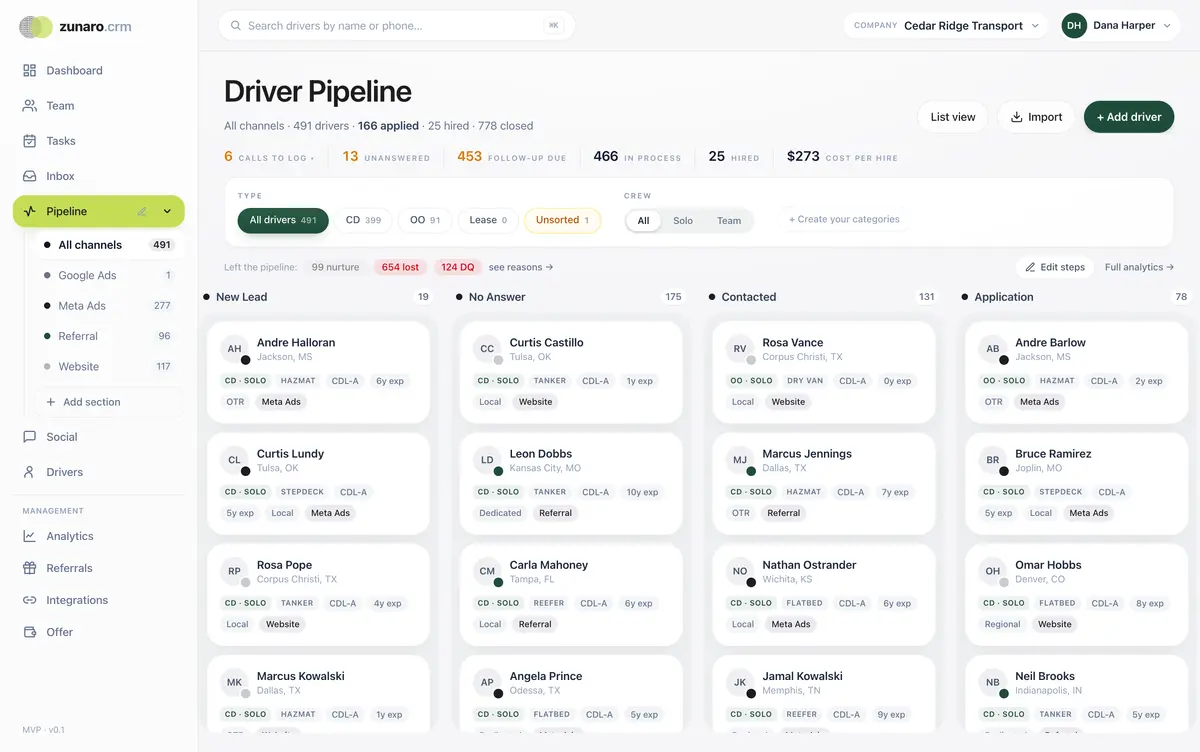
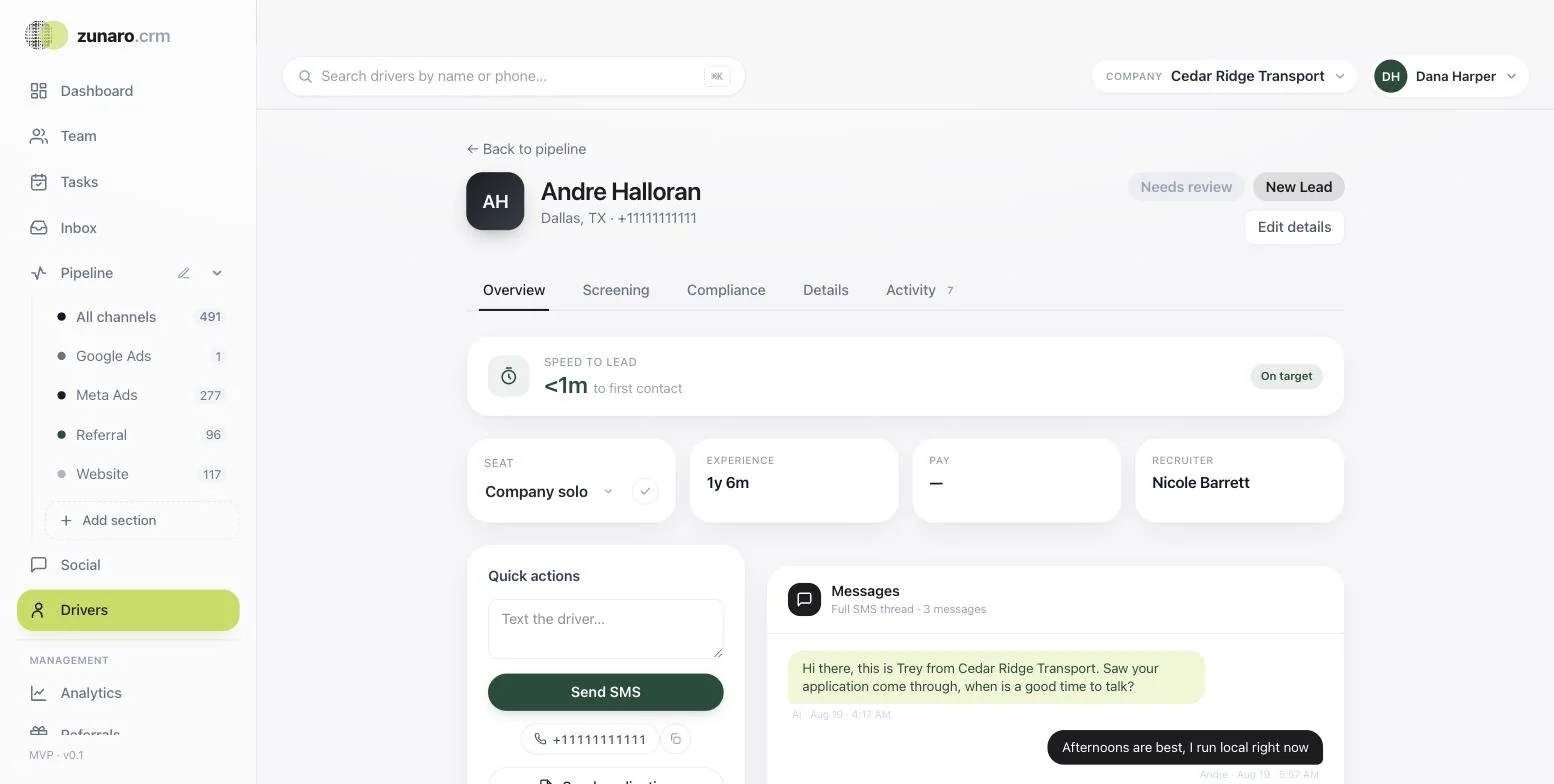
- We recommend Zunaro, the recruiting CRM built by our team, and we help you connect it

Built by our team, for driver hiring and nothing else. Leads from Meta, Google Ads, your website, calls and referrals land in one pipeline, the first text goes out automatically inside permitted hours, and every call and note stays on the driver's card. It reports cost per hire by channel, the number we optimize against. We help you connect it.
What a good lead from Meta actually is
A good lead is a driver who meets your basic criteria, left a real contact and is interested in your job. Getting hired is not part of this definition: it depends on things Meta can't see.
A lead is qualified if
- They hold a valid CDL of the class you need, per the form
- They live in your hiring area (for OTR that may be the whole country)
- They fit the job type, for example a company driver if you don't take owner-operators
- They report at least the experience you require
- The phone number is real, and they answer a call or text at least once
This does not make a lead bad
A truly bad lead is on us, and in our campaigns it's a rarity
A different country or a state outside the targeting, a fake number, someone with no CDL or no driving background at all. Campaign settings, form questions and SMS verification screen them out before they reach you. If one does slip through, send us examples, and we'll trace where they came from and fix the setup.
We strongly recommend SMS phone verification
The driver confirms the phone number with a code before submitting the form. That keeps out bots, typos and fake numbers. The trade-off: some drivers won't finish the form, so there are fewer leads and each costs a bit more. Verification can't make a driver pick up the phone later, which is still the recruiter's job.
One driver, several forms: not a glitch, a hot lead
The same person may fill out forms on different ads, for example a team position and a solo company position. That's not a bug and not a problem with the ads. It's normal, and it tells you something valuable: this driver is actively looking and open to more than one option. It also happens after we update a form: a driver may fill it out again simply because they don't remember applying before. That's normal too.
- Don't delete it as a duplicate: treat it as a sign of strong intent
- Call this driver first and offer the position that fits best
- Count them once in your hiring report, but keep both forms: they show which offers attract the same people
More questions, more expensive leads
Each additional question makes some people quit the form. Same budget, fewer applications, so each lead costs more. A filter saves your recruiter's time, so choose it deliberately and don't expect leads that are both cheap and perfectly filtered.
Short form
Name, phone, 1–2 questions
Lots of cheap leads, more unqualified ones. The recruiter filters on the call.
Medium form
Plus CDL, state, experience, job type
Enough volume, and the clear mismatches are already out.
Long form
Plus violations, accidents, equipment experience, consent to a background check
Few, expensive leads, and the answers still have to be verified.
- You name the deal-breakers: criteria that rule a driver out for sure.
- Only deal-breakers go into the form. Everything else the recruiter clarifies on the call.
- After any form change we wait about a week and compare cost and quality with the previous version.
- We never change the form and the creatives at the same time, or we can't tell what worked.
Why cost per lead is different for every carrier
There's no single market price for a lead. Two carriers running the same budget can pay very different prices, because the price depends on who you hire, where and with what offer.
Position
Solo company drivers are the largest pool. Teams and owner-operators are fewer.
Trailer type
Dry van draws the widest audience. Reefer, flatbed, tanker, hazmat or car hauler need specific experience or endorsements, so fewer drivers qualify.
OTR, regional or local
Each attracts a different driver. OTR means weeks away from home, local means home daily within a set radius. The audience size and the competition differ for each.
States and region
Some states have plenty of drivers, others few, and the number of carriers hiring there changes the auction price.
Strength of the offer
Pay, home time, sign-on bonus and equipment. A stronger offer gets more responses for the same money.
Length of the form
Each additional question means fewer submissions and a higher cost per lead, but better filtering. That's not bad, just a trade-off we balance together.
Season and competitors
When large carriers raise hiring budgets, the auction gets more expensive for everyone.
Fresh creatives: on us
A burned-out creative makes leads more expensive. We track response to every creative and replace it before the drop shows up in your cost per lead.
Your own benchmark appears in 2–3 weeks
Instead of comparing with numbers from the internet or another carrier, we build your benchmark from your own campaigns.
The number that matters: cost per hire
A low cost per lead means nothing if the driver never picks up. What matters is how much each hired driver costs you. Here is the same budget spent two ways.
Cheap leads
Low cost per lead, high cost per hireBetter-qualified leads
Higher cost per lead, lower cost per hireAn illustration, not real data. To count cost per hire, we need lead statuses from your side, which is one more reason to use a CRM.
Form answers need a check
A form holds the driver's words, not verified data. Some people answer "yes" to everything to make sure they get a call, or fill the form in seconds without reading.
- An owner-operator checks "company driver"
- Experience is inflated or includes non-CDL driving
- Violations, accidents or SAP go unmentioned
- They pick the state you hire from but live in another
No ad platform verifies answers. The recruiter's call and your screening (MVR, PSP, Clearinghouse) establish the truth. We can lower the share of such leads with multiple-choice questions instead of yes/no and requirements stated in the ad, but we can't remove them completely.
You hire in a very competitive market
A good CDL driver sees your job next to jobs from dozens of other carriers. After applying to you, they often apply to a few more companies the same day.
- Drivers compare. Pay, home time, truck age, sign-on bonus and pay speed get compared within minutes.
- The first to call is in the game. A lead called back the next day is often gone.
- Competitors set the price. When large carriers raise hiring budgets, the auction gets more expensive for everyone.
- The offer has to stand out. We'll find what makes you different and put it front and center in the ads.
Comments, messages and reputation bring drivers too
Not every interested driver fills out the form. Many first ask a question under the ad or message your page, and almost all of them look your company up before they say yes.
Comments under ads
Drivers ask about pay, home time and equipment right under the ad, and others read the answers. A quick, friendly reply builds trust. Unanswered questions or ignored negative comments push people away from the form.
Direct messages
Messages to your Facebook and Instagram page are leads too, and often warm ones. They need the same speed as a form: an answer within hours, not days.
Your online presence and reputation
Before applying, drivers check your company: the Facebook and Instagram pages, Google Maps, reviews and driver groups. An empty page, bad reviews or no Google Maps listing raise doubts, and some drivers won't apply or won't pick up the call. This isn't part of the Meta ads service, but it directly affects its results.
Illustrative examples, not a client account.
- Comments and page messages are handled by your recruiter. The agency runs the ads; replying to drivers is part of first contact. A missed comment is a missed driver.
- A "+" or a ZIP code in the comments means "I'm interested". Message this driver in Messenger or Instagram Direct the same day.
- Reply under the ad briefly and politely, then move the conversation to messages or a call. Other drivers read these replies too.
Your recruiter decides the outcome
Ads deliver a contact. A recruiter turns it into a driver. The same leads in different recruiters' hands give very different results.
Our recommended time to the first call after an application. The driver still remembers your company and hasn't talked to competitors yet.
| What the recruiter does | Why it matters |
|---|---|
| Makes several attempts | Call, text, retry at another time of day. Drivers are often behind the wheel; one missed call isn't a bad lead. |
| Sells the company | The driver is choosing between offers and listens to whoever is more convincing. |
| Stays in touch until orientation | Between "yes" and the first dispatch, a competitor can outbid you. |
| Marks every lead's status | That's how we see which creatives bring hires, not just applications. |
Why drivers don't pick up
Usually it's not about lead quality. The most common reasons:
- Your number shows up as spam. Many carriers' numbers get flagged as "Spam Likely", and drivers simply don't answer.
- The call came too late. A few hours later, the driver no longer remembers your job.
- Another carrier got there first. Good drivers are taken within hours.
- The driver is busy. They may be driving or simply have no time to talk right now.
If leads massively don't answer, first check that your number isn't flagged as spam. If the number is clean and the problem continues, we relaunch the campaign.
A fast call is the cheapest way to lower your cost per hire.
In short
Everything above on one screen. When these are in place, your ads work at full strength.
Before launch
- The offer is written in numbers: pay, home time, bonuses, equipment, lanes
- 3–5 deal-breakers for the form are named, e.g. CDL-A, state, experience, company driver
- You know who your competitors are and where you beat them
- Footage for creatives is filmed from our scripts and sent to us: trucks, drivers, real reviews
- A recruiter is assigned, gets leads instantly and has time for them
- Your recruiting phone number is checked: it doesn't show up as spam
- Lead destination is set: a CRM is best (your team connects it with the CRM's support), Meta Leads Center works to start
Every day
- Every new lead gets a call within 15 minutes during business hours
- No answer: a text and a retry at another time of day, at least 3 touches
- Form answers are double-checked on the call
- Comments under ads and page messages get an answer the same day; a "+" or a ZIP code gets a direct message
Every week
- Every lead has a status: no answer / not interested / failed screening / terms didn't fit / orientation / hired
- Statuses are sent to PixelCo
- Truly bad leads (wrong state, no CDL, fake number) are sent to us with examples
- Changes to terms or requirements reach us before we adjust the ads
More than 9 years of marketing for trucking companies. Here is the work behind your ads, most of which you never see:
Before launch
- We study your offer and compare it with competitors' job ads where you hire: in your states, or nationwide for OTR
- Campaign structure built around your hiring: positions, geography (nationwide for OTR or specific states) and route type
- Many creatives and ad sets launched at once to find the winners fast
- Video scripts and editing, banners and several versions of ad copy (you film the footage from our scripts)
- A lead form built around your deal-breakers, with SMS phone verification (recommended)
- Everything your team needs to connect a CRM: form names and IDs, the field list, Meta access and the Pixel ID
Every week
- Creative performance tracked, new ones tested when the data calls for it, weak ads turned off
- Budget moved to the ads that bring answered calls and hires
- Truly bad leads traced to the source and fixed
- Optimization by your lead statuses, aimed at cost per hire
- A report: lead cost, volume and quality by ad and position
More about us: pixelcous.com
Thank you for choosing PixelCo. We've laid everything out as it is, because results depend on both sides. On our side, we'll do everything to make your ads work at full strength. Let's build a steady flow of drivers together.