Google Ads (search) for trucking companies
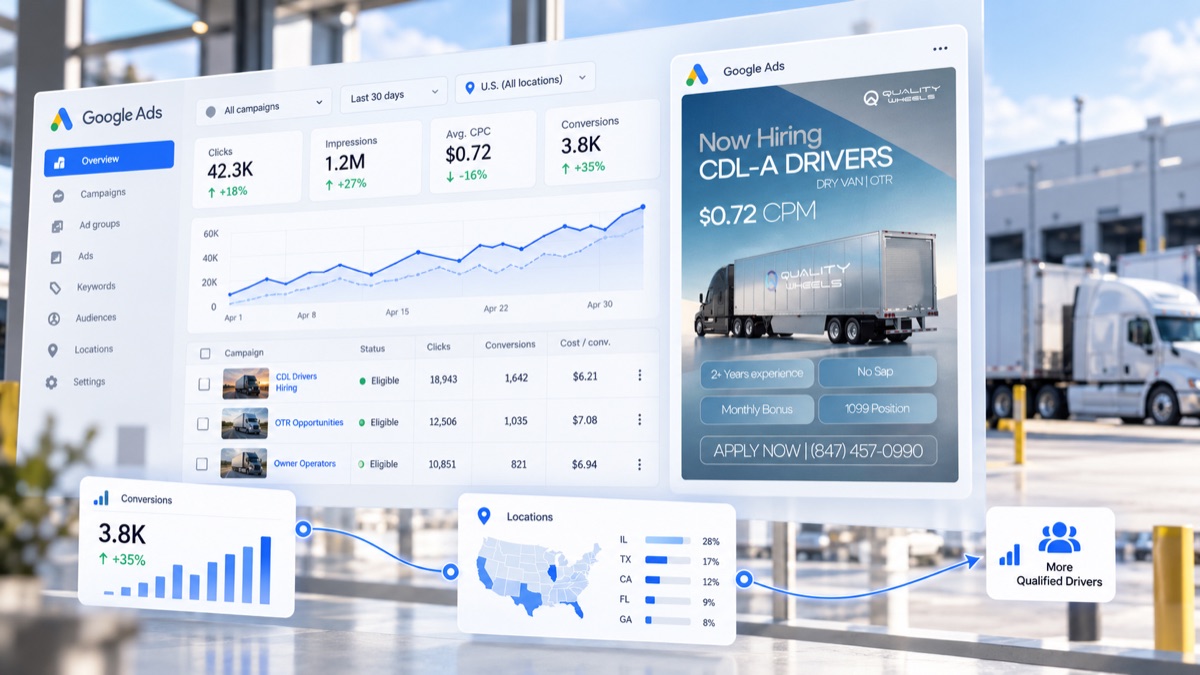
Google ads for trucking companies: reaching the drivers who are already searching
Published 8 October 2026 · by Yana Narynska, COO, Pixelco
Right now, somewhere in your states, a driver has decided to leave his carrier. He opens Google, types his class and his city, and hires whoever answers best. Google ads put your company in that search. We run the account end to end: campaigns, keywords, ads, and tracking that counts every application and every call.
This is the warmest traffic in driver recruiting. The man clicking your ad is not browsing. He has already made the decision and is now choosing between companies, and your ad is one of the options in front of him.
Below: what search does for a carrier, when it is worth starting, the five steps we run, and what the whole thing costs.
What Google ads do for a trucking company
Search works on intent. A driver types "CDL jobs Dallas" or "dry van company driver weekly pay" because he wants that today, not because an ad reminded him. Your ad does not have to create the interest. It has to be there when the interest already exists.
That makes the click expensive and the click valuable at the same time. Expensive, because every carrier in your state is bidding on the same few phrases. Valuable, because the man behind it is comparing employers, not killing time.
When to turn search on
The moment for Google is when Meta is already bringing drivers in steadily and you want more than it gives you. By then your name is in circulation: drivers have seen your trucks in the feed, and some of them have started typing the company into Google. That is demand your own advertising paid to create, and right now it goes to whoever is bidding on it.
Search is what collects it. The driver typing your company name is the cheapest click in the account and the likeliest to apply, because he has already heard something good about you. Next to him is the driver typing the job instead of the name: he decided to leave this week, he is comparing carriers tonight, and somebody hires him within days. Neither of those two is reachable anywhere else.
So search is the growth step, not the first one. It does not replace the channel that fills your seats. It puts your company in front of the hiring demand that already exists in your states, including the part you created yourself.
Delo Trans went in that order: years of recruiting advertising and content that put the name in the market, then search in 2026, once drivers were typing that name and the site could take the traffic. The full sequence is in how to build a steady flow of truck drivers.
Nine years. 500+ trucking companies. One industry.
We do not run restaurant ads between trucking clients. Every account in our portfolio is a carrier, a broker or a company that sells to them, and driver recruiting is what 9+ years and more than 500 trucking companies went into.



















































So your first campaign does not start from nothing. The phrases drivers actually type, the ones that only look right in a spreadsheet, the words that belong on the negative list before a dollar is spent, the numbers in an ad that make a driver click: we paid to learn all of it on other accounts. You get it on day one.
How the work runs
Five steps, and only the last one is an ad going live. Order matters here more than anywhere else in advertising, because a mistake in the first four is billed to you on every single click.
Step 1: your ad account and the company brief
The account is yours, not ours. Google Ads, the billing, the conversion tracking and the search history all stay in your name and we work inside them with access. If you ever leave, the history and everything the account has learned leave with you.
That matters more than it sounds. An account with a year of data behind it starts where a new one finishes, so opening a fresh account every time you change agencies throws away the most valuable thing you own in this channel.
The brief is the part only you can fill, and it is step one in your dashboard: who you hire, where you run, what you require and what a driver actually gets.
| Who you are hiring | Company drivers, owner-operators, lease, solo or team, and how many seats a month. Separate hires get separate campaigns. |
| Where you run | States, lanes and home terminals. Search is bought by geography, so this decides the map before it decides the budget. |
| Requirements | CDL class, months of experience, endorsements, driving record, truck year for owner-operators. These keep the budget off drivers you cannot hire. |
| The offer | Pay and how it is calculated, home time, equipment, bonuses, benefits. Search ads are short, so the numbers that go in them come from here. |
What the brief decides: the campaign map, the keyword list and every number that appears in an ad.
Step 2: the campaign map
A hiring account is never one campaign with everything in it. It splits along the two lines that change what a click costs: who you hire and where.
Company drivers and owner-operators are different jobs, they cost different money to recruit and they search in different words. Put them together and the budget quietly drifts to whichever is cheaper, which is almost never the seat you need filled this month. Each hire type gets its own campaign, keywords and ads.
Geography is the second line. A click in Dallas and a click in a small market cost different money and convert at different rates. Markets that earn their keep get their own budget line, so the ones that fill seats are not funded out of the same pot as the ones that do not.
| By hire type | Company drivers, owner-operators, lease, team. Separate campaigns, separate budgets. |
| By geography | States or metros where you actually run, each with its own line, so spend follows the markets that fill seats. |
| Brand, separately | Your own company name, kept apart from everything else. It is the cheapest traffic in the account and it should never compete with the rest for budget. |
| Budget pacing | Daily caps per campaign, so one expensive market cannot eat the month in a week. |
What the map decides: where the money goes before a single keyword is bid on.
Step 3: keywords, match types and the negative list
Keywords are simply what a driver types, and they fall into three groups that behave nothing alike. Job phrases: class, trailer, pay model, city. Your own company name: the cheapest and warmest traffic in the account. Competitor names: the fleets he is weighing you against.
The negative list is the half nobody talks about, and it is where the money leaks. Without it you pay for CDL schools, training programs, permit questions, salary surveys, jobs in other countries and every office vacancy that happens to contain the word trucking. We start the list from patterns we already know and add to it every week from your own search terms report.
Match types decide how far Google may wander from the phrase you bought. Broad brings volume and noise, exact brings precision and silence. A hiring account lives in between, and the setting moves as data arrives.
Step 4: the ads, the assets and conversion tracking
A search ad is a few lines of text, so it carries numbers, not adjectives. Pay and how it is calculated, home time, equipment year, hiring area. "Competitive pay" is what every other fleet in the auction wrote, and it tells a driver nothing.
Assets are the rest of the ad and they are free space in the auction: sitelinks to the application and to the pay page, callouts with the conditions that matter, structured snippets for equipment and lanes, the location asset, and the call asset.
Tracking is what makes the account improvable at all. A submitted application counts as a conversion, and so does a tracked phone call: drivers in search pick up the phone as often as they fill a form. Leave calls uncounted and the account looks half as good as it is, and then gets optimized in the wrong direction. Both are wired in before launch, never after.
Step 5: launch and optimization
One rule catches people out. Driver recruiting counts as employment advertising, and in the United States Google does not allow an employment campaign to be targeted by age, gender, parental status, marital status or ZIP code. Radius, city and state targeting stay, with a minimum radius of one kilometer. In practice that means the targeting work does not happen in the audience settings at all. It happens in the keywords, the geography and the offer.
Then one setting decides the rest: we optimize to the submitted application and the tracked call, never to the click or the page view. Point the algorithm at the wrong event and it becomes excellent at finding people who open your page and leave.
After that it is weekly work that does not end: the search terms report, new negatives, bids by market and by hour, one ad tested against another. A search account drifts faster than any other, because the auction around you changes every time another fleet in your state starts hiring.
Where the clicks land, and why the page decides the result
Search is the one channel that does not keep the application inside the platform. The click leaves Google and lands on a page of yours, and you have paid for it before the driver has read a word. A landing page or a carrier website is not an extra here. It is half the campaign.
This is where budget leaks, and it leaks quietly. A page that loads slowly on a phone, a form with twelve fields, an offer buried under the company history: each one of those is traffic you have already bought, walking away. The ads can be right and the account will still read as if search does not work for trucking.
If you already have a site, we audit it free of charge. You get the list of what has to change for driver traffic to convert: what belongs in the first screen, what the form is allowed to ask, where the application lands. Your developer implements it, or we do.
If you do not have one, we build it. A recruiting page has a working structure, and it is not a question of taste: the offer and the pay in the first screen, proof that the company is real, a short form that reaches the recruiter at once, a number that can be tapped from a phone. Change that order and the same budget brings fewer drivers.
Below is a carrier site we built for Special One Incorporated.
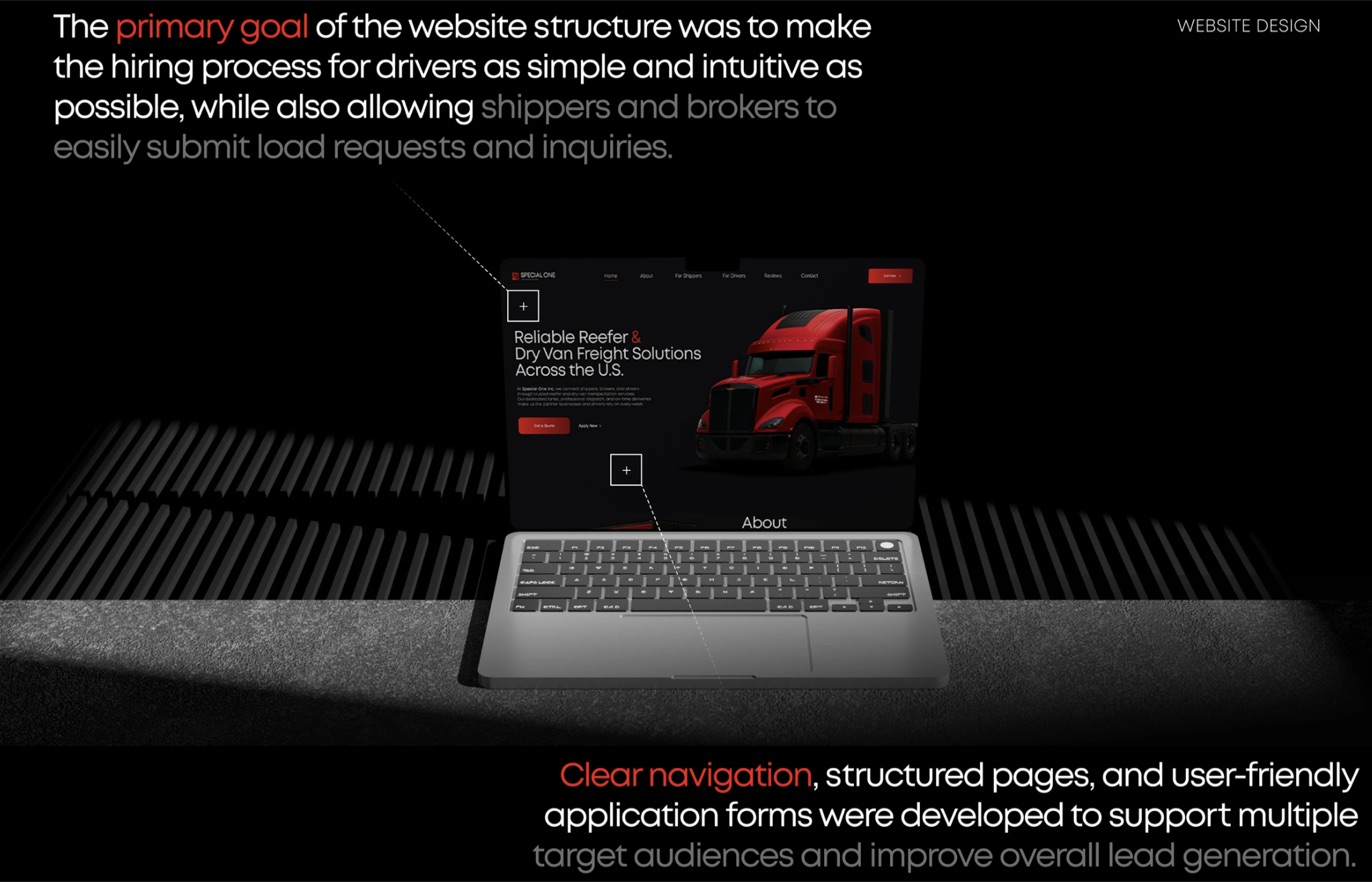
A landing page for one campaign is $1,750 and a full carrier website is $2,000 to $5,000, both listed on the carriers page.
What happens after a driver clicks
He lands on the page and either fills three fields or taps the number straight from the ad. The application goes wherever your applications already go, the call is logged against the campaign that produced it, and your recruiter calls back while the driver still remembers which company he applied to.
And none of it is spent once. Every application lands in a driver database that belongs to you and can be called again, and the account steadily learns which phrases end in a hired driver rather than in a form. Both of those stay with you.
What it costs
We do not publish what any client pays. These are our standard rates, the ones any carrier gets on the call.
| Google ads, service fee | $1,750 a month |
| Media budget | From $2,000 a month, paid to Google |
| Landing page or carrier website, if one is needed | $1,750 to $5,000, one time |
Pixelco rates, 2026. The media budget goes to the platform, not to us.
Measure the return against the cost of an empty seat per week, not against the invoice. What a seat costs while it waits, and what the rest of a hire costs after the advertising, is broken down in what it costs to hire a truck driver.
Google and Meta, where each one wins
Carriers ask which of the two to run. The honest answer is that they are not alternatives: they catch the same driver at two different moments. Meta Ads reach him before he has decided to leave. Search reaches him after.
| Meta | ||
| Who you reach | Drivers who are not looking yet | Drivers already typing the job |
| How much of it exists | Large, you set the ceiling with budget | Fixed, nobody can buy more of it |
| Cost per click | Lower | Higher, the auction is crowded |
| Where the form lives | Inside Facebook and Instagram | On your own page |
| What it depends on | The creative and the offer | Your page, your form and your name |
| When to start it | First | Once Meta is steady and you want growth |
The order is not a preference. Search converts on a name drivers already know, and that name is built in the feed first.
Google SEO and Google Ads: what the difference is
Both live on the same search page and answer the same query. Ads sit at the top and are paid for by the click. The results underneath are not bought, they are earned by the site itself, and that work is SEO.
The difference that matters to a carrier is speed against ownership. Ads can be live this week and bring applications the same week, and the day you stop paying the traffic stops with them: you are renting the spot. SEO is 6 to 12 months of work on the site, a page for each state and each type of hire, and once those pages rank they keep bringing drivers with no cost per click: you own the spot, but you cannot have it by Friday.
| Google Ads | SEO | |
| First applications | Days | 6 to 12 months |
| What you pay for | Every click | The work on the site |
| When you stop paying | Traffic stops that day | Pages keep working |
| What it depends on | Budget, keywords, the page | The site, the content, time |
| What it is for | Seats you need filled now | Not paying the auction next year |
Two different jobs on one search page.
They are not a choice between each other, and they pay each other back. The search terms report from a running ad account is the most honest list of what drivers actually type, which is exactly what the site should be built around. And a page that answers the query lowers what you pay for the click, because Google charges less for the ad that lands somewhere relevant.
So the order is simple. Ads fill the seats you have open this month. SEO is the work that makes next year cheaper, and we run it as a separate service.
FAQ
Do I need Google ads if Meta is already running?
Yes, and that is exactly the moment for it. Meta fills the seats and puts your name in circulation, and search collects the drivers who then type that name, together with the ones who decided to leave this week and are comparing carriers in Google tonight. Opening search before any of that means bidding on generic phrases against the whole state with nothing of your own in the mix.
What budget do I need for search?
It depends on your states and on how many seats you need a month. Search is bought by geography and the price per click is set by the fleets bidding next to you, so the honest answer is a range we narrow once we see your map and your brief. Our service fee for running it is $1,750 a month, and the media budget starts at $2,000 a month and goes to Google.
Do I need a website for this to work?
Yes, and this is the one channel where that is non negotiable. Search sends the driver onto a page of yours, so without a page that loads fast and takes an application there is nowhere to send him. If you have a site, we audit it free of charge and give you the list of fixes. If you do not, a landing page for the campaign is $1,750 and a full carrier site is $2,000 to $5,000.
How long before the first applications?
The account itself is a few days of work. The page sets the date: if your site already takes driver applications, search can be live inside the same week. If it does not, the page gets built first, and that is the real reason a search launch takes longer than a social one.
What if I have no Google accounts?
We create them for you, and that is included in the price: the Google Ads account, the Google Business Profile, analytics and conversion tracking, all in your name. Filling the Business Profile with photos and collecting the first reviews is work we guide, but the photos and the drivers have to come from the company.
Want to launch Google for your trucking company?
Get in touch and we will walk you through the process step by step and run an audit for you.
Book a call